
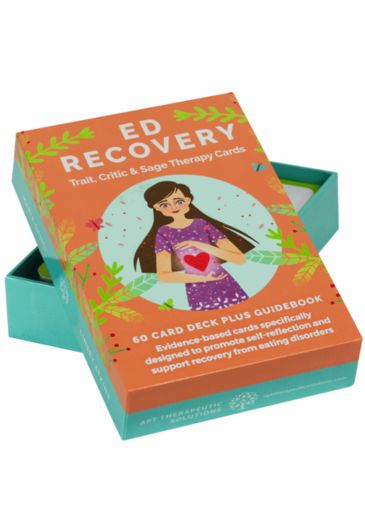





ED Recovery Therapy Cards by Maria Ganci and Dr Linsey Atkins

ED Recovery Therapy Cards

Supporting Engagement, Psychological Access, and Identity in Eating Disorder Treatment

Created for clinicians working with adolescents and adults when engagement feels fragile, resistance is high, and the eating disorder dominates the room.

The ED Recovery Therapy Cards offer a structured yet creative therapeutic approach to support psychological engagement, emotional connection, and self-understanding in eating disorder treatment. Grounded in empirical research and clinical wisdom, this visually engaging card set helps clinicians move beyond symptom-focused conversations and support clients to explore who they are beneath the eating disorder  safely, collaboratively, and at their own pace

Want to learn how to use these cards effectively?

Enroll in ED Therapy Cards: A Practical Guide for Clinicians.
When Engagement is the work

Many clinicians recognise this moment:

  • The adolescent shuts down, deflects, or becomes overwhelmed
  • Sessions feel dominated by the eating disorder voice
  • Insight exists, but emotional access does not
  • The clinician feels pressure to explain, convince, or push
In these moments, lack of engagement is not resistance  it is often a sign that the client feels
misunderstood, unsafe, or disconnected from their inner experience.
The ED Recovery Therapy Cards were developed to meet this exact clinical challenge.

 What the ED Recovery Therapy Cards Support 

Clinicians use these cards to:

  • Increase engagement without confrontation
  • Externalise the eating disorder and inner critical voices
  • Support reflection when verbal language is limited
  • Include the adolescent’s inner experience in treatment
  • Work developmentally alongside existing treatment models
The cards provide structure without rigidity and creativity without chaos, offering a shared
language that supports collaboration rather than compliance.
 
What’s Included in ED Recovery Therapy Cards
for Clinicians For use in eating disorder treatment with adolescents and adults
  • 60 beautifully designed, evidence-based therapy cards
  • Illustrated to support reflection, distance, and dialogue
  • A companion clinician guidebook
  • Designed to support both psychological and physical recovery
  • Suitable for individual and family-based work

The Therapeutic Journey

Understanding Personality Traits

The journey begins with the Personality Trait Cards, supporting clients to explore the traits that may have contributed to the development and maintenance of the eating disorder. Traits such as perfectionism, rigidity, and high standards  often experienced as flaws  are gently reframed. Clients are supported to understand how these traits once served them, and how they can become allies in recovery rather than sources of self-judgment. This stage lays the foundation for curiosity, self-compassion, and engagement.

Meeting the Inner Critics (Head Space)

The Inner Critic Cards help clients identify and externalise the harsh internal voices that dominate the head space  voices that amplify shame, fear, and self-doubt and reinforce the eating disorder. Clients are supported to observe where these voices come from and how they operate, creating psychological distance and reducing their power. This process often brings relief and validation,
particularly for adolescents who feel overwhelmed by internal pressure.

Discovering Inner Sages (heart Space)

As the grip of the inner critics softens, clients are introduced to the Inner Strength Cards, or SagesThese voices reside in the heart space and represent intuition, compassion, courage, creativity, and resilience  aspects of the self that exist independently of the eating disorder. Strengthening these voices supports reconnection with identity, values, and hope, and helps clients experience a growing sense of agency in recovery

Integration: Head and Heart Space

Throughout therapy, clients learn to observe and navigate the dialogue between:

  • Head Space — analytical, rule-driven, detail-focused
  • Heart Space — relational, intuitive, emotionally connected

With clinician guidance, clients are supported to quiet inner critics, strengthen inner sages, and integrate traits, emotions, and values into a more balanced and compassionate sense of self.

The Destination: A Stronger Sense of Self

The ultimate aim of the ED Recovery Therapy Cards is to support the development of a cohesive, confident, and empowered sense of self.
The cards allow clinicians to:

  •  Meet clients where they are emotionally and developmentally
  • Increase inclusion of the adolescent’s voice in treatment
  • Reduce resistance and clinician frustration
  • Support engagement alongside existing evidence-based models

Treatment becomes not only effective, but meaningful and human.

Is This Resource for You?

✔ Clinicians working with adolescents or adults with eating disorders
✔ Practitioners seeking to improve engagement and psychological access
✔ Therapists working alongside family-based or medical approaches

✖ Not a standalone treatment
✖ Not a scripted intervention
✖ Not designed to replace clinical judgment

Ready to add this to Your Clinical Toolkit?

Optional Clinical Support 

After purchasing the ED Recovery Therapy Cards, clinicians also have the option to join a private, clinician-only Facebook community. This space is available if and when it is helpful, particularly for:

  • reflecting on use of the cards in practice
  • working through engagement challenges
  • sharing clinical questions or stuck points
  • learning alongside other clinicians using the cards

I also join the community once per month for a live, informal session to answer questions and reflect on clinical use together. There is no expectation to participate Support is available when and if it is helpful.

Access details are provided after purchase. 

Want Support Using the Cards Confidently?

ED Therapy Cards Course – A Practical Guide for Clinicians

A developmentally informed, practical course designed to support safe, confident, and effective use of the cards in assessment, engagement, and ongoing treatment.

Shopping Cart

New Announcements from APT

• The ED Therapy Card Course is now open for enrollment.
• Dr Marion Roberts has joined APT as a Clinical and Research Lead